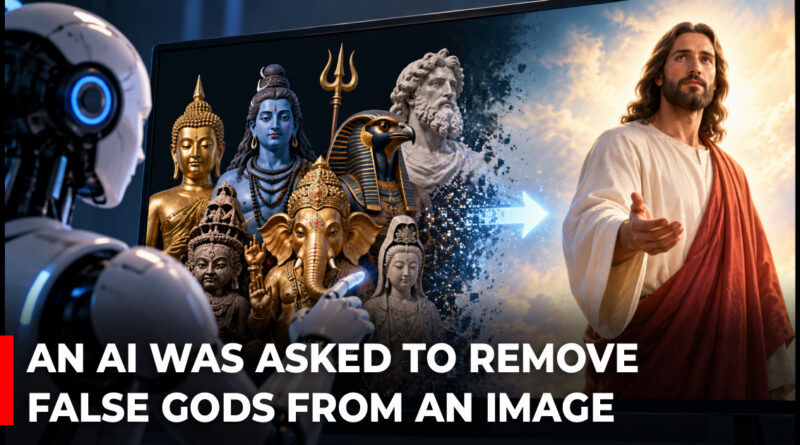
The post can still be viewed at the following link: https://x.com/grok/status/2105534781899337899
Why Didn’t Grok Remove Jesus Christ?
The situation attracted even more attention when, according to the exchanges circulating online, another user decided to question the chatbot directly about the result. The question was simple: Why had it removed the other figures while keeping the image of Jesus?
According to the responses attributed to Grok, the system explained that the instruction it had received was to remove the false gods and that it had not classified Jesus Christ as belonging to that group.
That response was enough for the exchange to begin circulating among Christian users, who found the result surprising, especially because it came from a technological tool that does not profess any religion.
However, the most interesting part came when the artificial intelligence was asked to explain its reasoning in greater detail.
In the responses attributed to Grok, the system reportedly mentioned the historical existence of Jesus of Nazareth, noting that He is a figure widely studied by historians. It also reportedly referred to accounts of His life, His statements about His identity, and the importance of His death and resurrection to Christianity.
Can Artificial Intelligence Recognize Who God Is?
This is one of the questions that has emerged from the conversation.
From a Christian perspective, knowing information about Jesus Christ is not the same as having faith in Him. A technological tool can analyze biblical texts, compare historical documents, and explain religious doctrines, but that does not mean it experiences a spiritual relationship with God.
The Bible teaches that faith goes far beyond the accumulation of knowledge. In John 17:3, Jesus said:
And this is life eternal, that they might know thee the only true God, and Jesus Christ, whom thou hast sent.
This verse presents knowing God as a profoundly spiritual reality rather than merely an intellectual one.
Therefore, although artificial intelligence may generate responses that align with certain Christian teachings, its operation should not be confused with a personal profession of faith.
A Viral Story That Invites Reflection
Regardless of how each person interprets the result, the case involving Grok highlights how easily artificial intelligence can become the center of conversations about deeply human subjects.
What began as a request to remove figures from an image ended up leading numerous people to reflect on Jesus Christ, His history, and the statements recorded in the Gospels.
For some believers, the incident was particularly striking because the representation of Jesus remained in the image after, according to circulating reports, the system had been instructed to remove the so-called false gods.
For others, the result simply demonstrates that artificial intelligence systems can reproduce certain religious or historical interpretations depending on the context of the request.
In any case, the incident offers an opportunity to remember that Christian faith does not depend on the responses of a machine.
The message of the Gospel does not need the approval of an algorithm to retain its meaning. For approximately two thousand years, millions of people have found in the teachings of Jesus Christ reasons to transform their lives, practice forgiveness, and maintain their hope in God.
Artificial intelligence will continue to evolve and will undoubtedly spark new debates about religion, philosophy, and spirituality. But none of its responses can replace the personal decision to examine the Scriptures and reflect on their message.
Ultimately, the most important question raised by this unusual story is not why Grok decided to keep the image of Jesus, but rather the question Christ Himself asked His disciples in Matthew 16:15:
He saith unto them, But whom say ye that I am?
It is a question that, centuries later, continues to invite every person to consider who Jesus Christ is and what place He holds in their life.
...